

Grain Rot Steam Launch - What 350k Demo Downloads Taught Two-Person Studios 2026
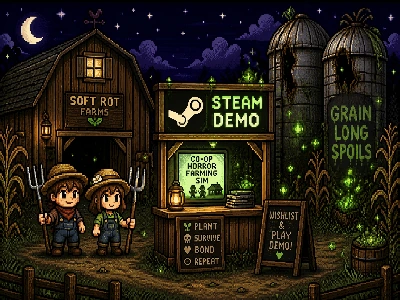
If you are searching grain rot steam launch in the week after August 7, 2026, you already know the celebration numbers: more than 350,000 demo downloads, a Top 15 most-played demo at Steam Next Fest, roughly 250,000 wishlists, a 1 hour 28 minute average demo session, a #1 trending YouTube gameplay clip from a large creator, and a $9.99 Steam release (launch-week $8.99). The Games Press launch release and Steam store page are the primary pins for those claims. What the SERP still lacks is the useful question for a two-person studio: which parts of that path are reproducible operator work, and which parts are genre-wave lottery tickets you should not budget against?
This article is a case playbook, not a review and not a "how they went viral" myth. Beck & Branch Games (Stockholm, two-person) and publisher Neem Interactive shipped a co-op extraction horror on Unreal. Press coverage repeats the lore. Your job is to extract gates, worksheets, and hold criteria you can run on your own demo-to-paid calendar without pretending you have their YouTube distribution.
Non-repetition: this is not a generic Next Fest prep checklist like Steam Next Fest 2026 prep, and it is not a wishlist-plateau diagnostic like post-fest wishlist plateau playbook. This URL owns one intent: what Grain Rot's demo → paid conversion path teaches small teams to copy carefully after the Aug 7, 2026 launch.
| Audience | Start here | Done when |
|---|---|---|
| Beginner / first Steam ship | Snapshot table + copy/don't-copy matrix | You know which numbers are vanity |
| Solo / two-person operator | G1–G6 evening reconstruction | Receipt lists your next demo gates |
| Studio lead / company | CapEx + Discord free-day risk | You can say no to a copycat free-day |
| Creator / community | Shareable lessons list | Discord post that is not "we need to go viral" |
Time estimate: 90-150 minutes to rebuild the case into your own worksheet. You do not need to play 20 hours of Grain Rot to learn from the published funnel.
Default recommendation: copy the durable operators - demo session length that earns retention, wishlist milestone honesty, solo/small-group balance after demo feedback, launch-week price clarity, AI disclosure hygiene. Hold any plan that assumes a top creator will make you #1 trending, that a Discord free full-game day is risk-free, or that 350k demos are a normal baseline for a two-person first ship.
Snapshot - what the public record actually says
| Signal | Public figure | Source type | Use carefully as… |
|---|---|---|---|
| Demo downloads | >350,000 | Publisher launch release | Demand ceiling signal, not a forecast for your next demo |
| Next Fest placement | Top 15 most-played demo | Publisher + press | Proof the demo retained players during Fest week |
| Wishlists | ~250,000 (cleared a 200,000 milestone) | Press citing studio | Conversion funnel mid-point, not sales |
| Demo session length | 1h 28m average | Press citing studio | Design target for "worth a second session" |
| Creator spike | #1 trending gameplay (SMii7Y cited) | Publisher release | Non-replicable distribution event |
| Price | $9.99 / launch week $8.99 (10% off) | Games Press + store | Impulse-friendly co-op price band |
| Team | Two-person studio + publisher | Press | Capacity constraint for your CapEx math |
| Engine / players | Unreal; 1–4 online co-op | Fast facts | Genre and tech assumptions |
| Pre-launch Discord day | Full game free 24h for verified Discord members (Aug 1) | Tech press | High-risk community stress test, not a default |
Secondary coverage such as Age of The Nerd's launch write-up restates the same funnel numbers and situates the game in the Lethal Company / R.E.P.O. social-horror wave. Treat the wave as context, not as a promise that the next extraction co-op will inherit the same audience.
Copy vs do-not-copy matrix (print this)
| Pattern | Copy? | Why |
|---|---|---|
| Demo long enough for a full co-op evening (≈90 minutes) | Yes | Session length is a design choice you control |
| Ship a demo that is the genre thesis, not a teaser trailer | Yes | Extraction co-op sells on shared failure clips |
| Rebalance solo / small lobby after demo feedback | Yes | Cheap, high-trust operator work |
| Clear launch price + short launch-week discount | Yes | Reduces buyer ambiguity |
| Wishlist milestone storytelling (200k → 250k) | Yes, carefully | Motivation for community; do not fake milestones |
| Publisher for press + store ops | Maybe | Capacity trade, not magic |
| Discord free full-game day before launch | Hold | Stress-test upside + refund/leak/expectation downside |
| Betting the calendar on a #1 trending YouTube video | No | Distribution lottery |
| Assuming 350k demos is a two-person baseline | No | Survivorship bias |
| Copying AI voice disclosure as a strategy | No | Disclose if you use it; do not chase controversy |
The rest of this article turns the Yes rows into gates you can run, and the Hold/No rows into explicit refusal language for partners and Discord.
Monday ritual - reconstruct the funnel in one evening (G1–G6)
| Minute | Gate | Evidence you keep | Pass when |
|---|---|---|---|
| 0-20 | G1 Public number audit | Table of claims + source URLs | Every big number has a cite |
| 20-45 | G2 Demo product thesis | One-sentence "why clip?" | You can name the shareable failure |
| 45-70 | G3 Session-length design | Target minutes + cut list | Demo plan hits ≥45–90 min useful play |
| 70-95 | G4 Wishlist milestone plan | Honest thresholds | No fake counters |
| 95-120 | G5 Pre-launch community risk | Discord free-day decision | Explicit keep/hold on free full build |
| 120-150 | G6 Launch CapEx + receipt | grain_rot_case_lessons_receipt_v1.json |
Decision written |
If you only have an hour, do G1–G3. Most failed "we need a viral demo" plans fail before marketing - the demo is not a product people can fail together in.
G1 - Separate celebration from operator truth
Write three columns for any case study you read this year:
- Publisher-stated (press release numbers).
- Store-observable (review count, price, tags, playtime if shown).
- Unobservable to outsiders (exact conversion rate, revenue, cost of the YouTube spike).
For Grain Rot, G1 already teaches a discipline: do not invent a conversion rate. A 350k-demo → 250k-wishlist story is impressive and still does not tell you paid conversion. Your own receipt should measure what Steamworks actually shows you - wishlists, traffic, sales - not a fantasy multiplier copied from someone else's press kit.
G2 - The product thesis that made the demo clipable
Public materials emphasize the same thesis: four friends, extraction pressure, furniture-as-physics comedy, and a death model where a Living Spark keeps participating after the wooden vessel breaks. That last point is the design lesson, not the lore.
Operator translation: your demo must expose the one mechanic that creates new clip types for this genre wave. Lethal Company already owns "quota panic." R.E.P.O. already owns its own physics chaos. Grain Rot's public differentiator is death-as-agency plus outpost progression between runs. If your demo only proves "we also have dark hallways and loot," you are competing on marketing budget you do not have.
Write your thesis as one line:
Players fail together in a way that creates a new kind of clip, not a worse remake of last year's hit.
If you cannot write that line without naming another game's mechanic, hold the Fest date.
G3 - Session length as a retention instrument
An average demo session of 1 hour 28 minutes is not an accident of "people liked it." It is a design signal: the loop supported a full evening with friends. For small teams, that usually means:
- Onboarding under 10 minutes without a lore lecture.
- A first extraction that can succeed or fail in 20–30 minutes.
- Enough progression tease (outpost / unlock) that a second session feels justified.
- Performance and join-flow that does not kill the party before the joke starts.
Target worksheet (fill your numbers):
| Stage | Your target | Cut if over |
|---|---|---|
| Install → first move | ≤5 min | Tutorial walls |
| First extraction attempt | 20–35 min | Overlong map |
| Party "one more run" hook | Visible by minute 40 | No between-run reward |
| Soft stop | 60–90 min | Content that needs the full game |
Pair this with instrumentation thinking from Steam Next Fest demo retention funnel resources and the demo retention funnel playbook. You do not need Grain Rot's scale to measure your D1 return and median session.
G4 - Wishlist milestones without lying
Press cites clearing 200k and reaching about 250k wishlists. Milestone storytelling works because communities like scoreboards. It fails when studios invent thresholds, celebrate private builds as "wishlists," or treat wishlist count as revenue.
Honest milestone rules:
- Only announce numbers you can defend from Steamworks.
- Prefer rate stories ("velocity doubled after trailer X") over absolute flex when your absolute is small.
- Never set a partner KPI that assumes Grain Rot's absolute scale.
- Keep a parallel wishlists vs page visits review so traffic vanity does not fool you.
For reporting templates you can actually maintain, use wishlist-to-launch KPI scorecards.
G5 - The Discord free-day: stress test or self-own?
Tech coverage described an August 1 Discord-only window: verified members ("Scrappies") could play the full 1.0 build free for 24 hours, with prizes for top scrap collectors, six days before the public Steam launch. That is a bold operator move. It is also easy to cargo-cult badly.
Upside (when you have a real community):
- Live load test before paid launch.
- Bug reports from the people most willing to file them.
- Loyalty reward that converts Discord lurkers into invested players.
- Clip fuel in the final week.
Downside (especially for smaller Discords):
- Expectation that "the game is free" spreads beyond the server.
- Review bombing risk if the free day build is rougher than launch.
- Support load that a two-person team cannot staff.
- Key/access leakage and chargeback weirdness if you mishandle entitlements.
- Cannibalizing launch-week paid conversions among the exact cohort most likely to buy.
Hold criteria - ship a free full-build day only if all are true:
| Gate | Required |
|---|---|
| Discord size | Large enough that load test is real, not cosplay |
| Build quality | Same or better than what you will sell on day one |
| Entitlement plan | Written: who gets access, how it ends, how leaks are revoked |
| Support staffing | Named owner for the 24h window |
| Message discipline | Public posts say Discord stress test, not free forever |
| Review plan | You accept that some free-day players will review early |
If any row fails, run a closed playtest or a demo update instead. That is the two-person-safe version of the same idea.
G6 - Launch CapEx four-liner + receipt
- Scope - reconstruct lessons into your demo plan; do not rebuild your game into Grain Rot.
- Cost - time only for the worksheet; publisher spend is a separate decision with its own diligence.
- Trap - budgeting marketing as if a top creator spike is scheduled.
- Owner - one person owns demo session targets, wishlist honesty, and the free-day keep/hold.
grain_rot_case_lessons_receipt_v1.json:
{
  "receipt": "grain_rot_case_lessons_receipt_v1",
  "studied_launch": "2026-08-07",
  "g1_sources_cited": true,
  "g2_thesis_one_liner": "fill",
  "g3_demo_session_target_minutes": 90,
  "g4_wishlist_milestones_honest": true,
  "g5_discord_free_day": "hold",
  "g5_hold_reason": "support_staffing|build_parity|message_risk",
  "copy_list": ["session_length", "solo_rebalance", "price_clarity"],
  "do_not_copy_list": ["creator_lottery", "350k_baseline"],
  "decision": "apply_operators_only",
  "revisit_on": "2026-10-01"
}
$9.99 launch math for two-person studios (honest, not predictive)
Grain Rot priced at $9.99 with a 10% launch-week cut to $8.99. In the co-op party genre, that price band reads as "buy three friends in" more than "premium single-player." Useful questions for your team:
| Question | Why it matters |
|---|---|
| Is the game a party buy or a solo prestige buy? | Price elasticity differs |
| Does a 10% launch week discount create urgency without training players to wait? | Short windows beat perpetual "launch sales" |
| Can you support refunds and co-op join bugs at this volume? | Cheap price increases support incidents |
| Are regional prices coherent for gift purchases? | Cross-region gifting is easier after the July 2026 Steam update - see wishlist categories share funnel |
Do not reverse-engineer their revenue from wishlists. You do not have the conversion rate. Build a floor plan: "If we convert X% of our real wishlists at our real price, do we cover contractor and living costs for N months?" If the answer depends on a SMii7Y-scale spike, the plan is fiction.
Genre-wave honesty - why this is not a template for every indie
The durable co-op horror / party-failure wave (Lethal Company lineage, R.E.P.O., and peers) creates a distribution environment where clip culture does unpaid UA. Grain Rot sits inside that environment. A narrative adventure, a precision platformer, or a management sim does not automatically inherit it.
If your game is not clip-native:
- Do not schedule a Next Fest demo as if Fest alone creates 350k downloads.
- Invest in clearer store thesis and longer-form creator outreach with smaller, relevant channels.
- Measure success as qualified wishlists and demo return rate, not raw download vanity.
If your game is clip-native:
- Design the first 30 minutes for recoverable failure comedy.
- Make join/rejoin painless (this is where two-person teams die).
- Patch the demo during Fest when possible; responsiveness is part of the story press told about Beck & Branch.
For October Fest metadata and Steam Input readiness, keep the Next Fest demo metadata checklist resources next to this case so marketing ambition does not outrun upload gates. If your last Fest left a plateau, diagnose with the post-fest wishlist plateau playbook before you copy someone else's celebration math.
AI disclosure as diligence, not discourse bait
Public coverage notes an AI-generated content disclosure on the Steam page for a small number of character voice-overs, plus community disagreement. The operator lesson is boring and correct:
- If you use generative AI in a disclosable way, disclose on the store page.
- Do not treat disclosure as marketing.
- Do not treat community anger as proof you should hide the tool.
- Budget for some lost sales if your audience is disclosure-sensitive - that is a product audience fit question.
Two-person CapEx often forces tool tradeoffs. Honesty beats surprise.
Failure modes when teams cargo-cult this launch
| Mistake | What it looks like | Fix |
|---|---|---|
| "We need 350k demos" as a KPI | Panic marketing, empty promises | Set session-length and return-rate KPIs you can observe |
| Free full game on Discord without staffing | Meltdown weekend | Closed playtest instead |
| Demo is a trailer with a level | No clips, no retention | Cut scope until the thesis is playable |
| Ignoring solo balance | Good Fest numbers, angry solo reviews | Rebalance after demo feedback like they did |
| Eternal launch discount | Trained waiters | One short launch-week cut, then stop |
| Copying Unreal because they used Unreal | Engine cargo cult | Pick the engine your team can ship |
| Celebrating wishlists as revenue | Cash-flow surprise | Build a conversion floor model |
Beginner glossary
- Demo downloads - installs of the free demo build; not sales.
- Most-played demo (Next Fest) - Fest-week engagement ranking; retention + concurrency signal.
- Wishlist - Steam intent signal; still not a purchase.
- Extraction co-op - enter, loot under pressure, escape; social failure is content.
- Living Spark (Grain Rot) - post-death agency model described in their materials; design idea to study, not a feature to clone blindly.
- Launch-week discount - short introductory cut; different from a seasonal sale.
- Publisher - capacity and reach partner; not a substitute for a clipable demo.
What to do on your next Monday (creator share card)
Paste this into Discord after your team reads the case:
Grain Rot's Aug 2026 launch proves a two-person studio can ride a huge demo - but the copyable parts are session length, thesis clarity, solo rebalance, honest wishlist storytelling, and price clarity. The non-copyable parts are a #1 YouTube spike and treating 350k demos as normal. Our next action: set a demo session target and a free-day hold decision. Not "go viral."
Key takeaways
- Grain Rot launched August 7, 2026 at $9.99 ($8.99 launch week) after a mega-viral demo path publicly tied to 350k+ downloads and ~250k wishlists.
- The useful study is demo product design + operator discipline, not lore recap.
- A ~90-minute average demo session is a design target worth copying in spirit.
- Wishlist milestones work only when the numbers are defensible.
- A Discord free full-game day is a high-risk stress test - default to hold unless staffing and build parity pass.
- Creator #1 trending spikes are not a scheduleable line item.
- Price the game for how people buy it (party vs prestige), not for someone else's chart position.
- Genre-wave clip culture is environmental advantage - admit when you do not have it.
- Disclose AI use if required; do not weaponize the disclosure.
- Write a receipt that lists copy and do-not-copy so the next sprint cannot "accidentally" budget the lottery.
FAQ
What can two-person studios learn from the Grain Rot Steam launch? Prioritize a demo that delivers a full social session, a clear clip thesis, post-demo balance passes for solo/small lobbies, honest wishlist communication, and simple launch pricing. Do not treat 350k downloads or a top YouTube spike as a planning baseline.
How many demo downloads did Grain Rot get before launch? Publisher materials cite more than 350,000 demo downloads, with Top 15 Next Fest most-played placement. Treat that as their ceiling story, not your forecast.
What was Grain Rot's launch price on Steam? $9.99 USD, with a 10% launch-week discount to $8.99, per the August 7, 2026 Games Press release and store positioning.
Did Grain Rot give the full game away on Discord before launch? Press reported a 24-hour free full-game access window for verified Discord members on August 1, 2026, before the August 7 public launch. That is a risky tactic to copy without staffing and entitlement planning.
Is 250,000 wishlists a realistic goal for every indie? No. It is an outlier outcome in a hot genre wave with strong creator amplification. Set goals from your own traffic and conversion history.
Should my studio copy the Living Spark death mechanic? Study the principle - keep failed players useful - only if it fits your fantasy and engineering budget. Cloning a named mechanic without the surrounding loop usually produces a worse remake.
How should we measure success if we cannot match their scale? Median demo session length, demo return rate, wishlist velocity after concrete patches/trailers, join success rate for co-op, and a conversion floor model against your wishlist count.
Where should I read official details? Start with the Games Press launch release and the Steam store page for GRAIN ROT.
Related reading
- Steam Wishlist Categories - Indie Share Funnel Keep Hold After July 2026 Update
- Post-Next-Fest Wishlist Plateau Diagnostic Playbook for Small Teams 2026
- Steam Next Fest 2026 Prep Checklist for Indie Devs
- Steam Next Fest Demo Retention Funnel Instrumentation 2026
- Steam Wishlists Versus Page Visits for First-Time Devs 2026
- From Zero to 1k Wishlists - My Steam Page Optimization Journey
- 18 Free Wishlist-to-Launch Reporting Templates and KPI Scorecards
- 15 Free Steam Next Fest Demo Retention Funnel Instrumentation Resources
- 15 Free Steam Next Fest October 2026 Demo Metadata Checklist Resources
- Steam Short Description 300-Character Limit CJK Export Fix