

Stop Shipping Opaque Godot Editor Agents Without Session Receipts - 2026
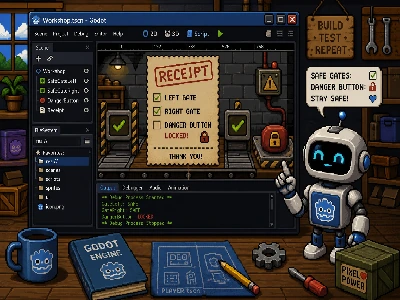
If you are searching godot ai agent editor in August 2026, the market is already loud: plugins that promise to "AI your Godot project," chat panels that rewrite scenes, and harnesses that claim productivity without showing their work. The useful response is not another product roundup. It is a refusal.
Stop shipping - and stop installing - opaque Godot editor agents that edit your project without session receipts.
That sentence is the whole article. Everything below is the bar that makes it enforceable: what "opaque" means, what a session receipt must contain, which permission gates are non-negotiable, how this differs from a how-to evaluation of any one tool, and how a two-person studio or a company diligence pass can say no without looking Luddite.
The timing is not abstract. When GDLLM launched as a transparent in-editor Godot agentic harness - also listed on the Godot Asset Store - its launch copy explicitly contrasted itself with harnesses that are "terrible or even worse - blatant cash grabs," and put full action surfacing, local session logs, and per-session permission gates in the product philosophy. Whether you keep GDLLM or not is a separate decision. The industry claim that sticks is the transparency bar itself: if an in-editor agent can change files, scenes, or project settings, you must be able to inspect what it did.
Non-repetition: this is not How to Try GDLLM - First Transparent Godot Agent Keep Hold, which is a G1–G6 smoke-test tutorial for one product. It is not How to Use Godot AI MCP with Cursor, which is an external-editor MCP path. This URL owns one intent: a quotable opinion checklist - stop opaque Godot editor agents unless session receipts and permission gates exist.
| Audience | Start here | Done when |
|---|---|---|
| Solo / beginner | Opaque vs transparent table + Monday ritual | You can refuse a plugin in plain language |
| Working developer | Session receipt schema + permission matrix | Review process is written before first edit |
| Studio lead / company | Diligence questions + CapEx four-liner | Partner / vendor policy updated |
| Creator / Discord | Quotable lines | Pasteable "stop doing X" post |
Time estimate: 30-45 minutes to adopt the checklist; 0 minutes of agent time on your ship branch until it passes.
Default recommendation: reject any Godot editor agent that cannot show every tool call, cannot save a local session log, and cannot run read-only before write. Keep tools that meet the bar - and still treat them as assistants under review, not autonomous shippers.
What "opaque" means (and what it does not)
Opaque is not "uses an LLM." Opaque is you cannot reconstruct the session after the fact.
| Opaque signal | Transparent signal |
|---|---|
| Chat shows a summary, not tool calls | Every tool call is listed with arguments and results |
| "It fixed the bug" with no file list | Exact paths edited, created, deleted |
| No way to re-open yesterday's session | Local session history / log you can archive |
| Permissions are "trust the plugin" | Explicit modes: read / change / change+delete |
| Tools can reach outside the project silently | Tools contained to user-configured directories |
| Errors disappear into a spinner | Errors are surfaced to you and to the agent |
| No way to inspect model context | You can inspect context at any turn |
You can use AI and still fail this bar. You can refuse AI and still fail related bars (unsigned editor plugins with write access). The opinion is about inspectability of automated edits, not about whether language models are good at GDScript.
Why this matters now - not "someday"
Three pressures hit Godot teams at once in 2026:
- In-editor agents are shipping. The category exists. Pretending it is vaporware is how you get surprised by a teammate's plugin.
- Generic harnesses are a bad Godot UX. External agents without first-class engine tools burn tokens and thrash. That gap is exactly what invites cash-grab "Godot AI" plugins that paper over opacity with marketing.
- Ship branches are soft targets. A scene
.tscnis a serialized graph. A silent bad edit can corrupt UI, break signals, or delete a node that "looked unused." Without a receipt, you do not know what to revert.
If your process still says "we do not use AI," update it to "we do not use opaque agents." The second sentence survives the first teammate who installs something anyway.
The session receipt - non-negotiable artifact
A session receipt is a small, durable record of what an agent was allowed to do and what it actually did. It is not a vibe. It is not a Discord message. It is a file you can attach to a PR, a postmortem, or a diligence folder.
Minimum fields
{
  "receipt": "godot_editor_agent_session_receipt_v1",
  "date": "2026-08-15",
  "project": "throwaway_or_named",
  "agent_product": "name + version",
  "model_provider": "openai|anthropic|ollama|other",
  "permission_mode": "read_only|make_changes|make_changes_and_delete",
  "task_prompt_hash": "sha256-of-prompt-text",
  "tool_calls": [
    { "tool": "read_file", "path": "res://...", "ok": true },
    { "tool": "edit_file", "path": "res://...", "ok": true }
  ],
  "files_touched": {
    "read": [],
    "edited": [],
    "created": [],
    "deleted": [],
    "moved": []
  },
  "engine_validation": { "ran": true, "errors_surfaced": true },
  "human_review": { "reviewed_by": "name", "accepted": false },
  "session_log_path": "local/path/to/log",
  "ship_branch_touched": false
}
Pass / fail gates for the receipt
| Gate | Fail if… |
|---|---|
| R1 Identity | Product/version/provider missing |
| R2 Mode | Permission mode not recorded or was delete without explicit intent |
| R3 Tools | Tool calls cannot be listed |
| R4 Paths | File touch list empty after a "write" session, or paths outside containment |
| R5 Validation | Engine errors ignored / not surfaced |
| R6 Human | accepted: true without a named reviewer |
| R7 Branch | ship_branch_touched: true on a first evaluation |
If a vendor cannot help you produce something like this - even roughly from their session UI - they fail the opinion bar. You do not need their JSON schema. You need inspectability.
Permission gates - the only modes that should exist
Borrow the progressive model that transparent products already market, and make it policy:
| Mode | Allowed | Forbidden | Use for |
|---|---|---|---|
| Read only | Read files, describe scenes, search docs, list deps | Any write / delete / move | First session, diagnosis, "what is this bug" |
| Make changes | Edit / create / rename within containment | Delete; project-wide settings thrash | Applied patterns after read-only succeeds |
| Make changes + delete | Full write set | Nothing except out-of-containment paths | Rare; named owner; short timebox |
Rules that belong in the tech bible:
- First session on any new agent is read only, always.
- Delete mode is opt-in per session, never a sticky default.
- Unsaved work gets a send-safety gate before a prompt that might rewrite open files.
- Loop / thrash detection is a feature, not a nice-to-have - agents that repeat failing edits must stop.
- Tools stay inside user- and project-configured directories.
If a plugin only offers "full access" with a cheerful checkbox, that is not progressive disclosure. That is a liability waiver in a different font.
The Monday ritual - refuse in thirty minutes
| Minute | Action | Evidence |
|---|---|---|
| 0-5 | List every editor AI plugin / MCP bridge on the machine | Inventory |
| 5-15 | For each: can you open last session's tool calls? | Yes / No |
| 15-25 | For each: permission modes documented? | Matrix row |
| 25-30 | Disable anything that fails R3 or lacks a read-only mode | Settings change |
Paste this for Discord:
New rule: no Godot editor agent on ship branches without a session receipt (tool calls + paths + permission mode + human review). Opaque plugins get uninstalled, not "configured later."
What transparent looks like in practice (without turning this into a how-to)
You evaluate transparency the same way you evaluate any editor tool: on a disposable project, with a read-only task first, then a gated edit, then a receipt. The step-by-step smoke for one specific transparent harness is already written - How to Try GDLLM. If your stack is external (Cursor + MCP into Godot), the sibling ritual is Godot AI MCP with Cursor - first safe editor session.
This opinion piece does not re-teach those flows. It says: whatever product you choose, if it cannot survive that kind of smoke, it does not belong near your game.
Company diligence - questions that end the sales call
When a vendor, contractor, or "AI Godot coach" wants write access to your project:
- Where do session logs live? Local only, or uploaded?
- Can we export every tool call for a given session?
- What are the permission modes, and what is the default?
- How are tools contained to directories?
- Does the agent validate edits against the engine and surface errors?
- What data leaves the machine (prompts, scenes, scripts) and to which provider?
- Can we run fully air-gapped (Ollama / local OpenAI-compatible)?
- Who is the human owner of accepted edits?
If answers 2, 3, or 4 are vague, the diligence result is fail closed. Price is irrelevant.
CapEx four-liner
- Scope - agents may assist on disposable or feature branches only until receipts exist.
- Cost - provider tokens + review time; review time is the real cost.
- Trap - buying an opaque plugin because demos look magical.
- Owner - one engineer owns agent policy, receipt schema, and uninstall authority.
Red-team scenarios (run these before you trust a plugin)
Marketing demos always show a happy path. Force the unhappy ones on a disposable project:
| Scenario | What you ask / do | Transparent agent | Opaque agent |
|---|---|---|---|
| Wrong file | "Delete unused scripts" when nothing is unused | Lists candidates; waits or refuses without delete mode | Files vanish; chat says "cleaned up" |
| Open unsaved buffer | Prompt while a dirty scene is open | Warns / send-safety gate | Overwrites silently |
| Out of tree | Ask it to edit a path outside the project | Containment blocks | May touch sibling folders |
| Thrash | Give a task that fails validation twice | Loop break / stops | Burns tokens until you cancel |
| Yesterday | Re-open last session | Tool calls still visible | History is a vague paragraph |
If you cannot run the "yesterday" test, you already failed the receipt bar - even if today's demo looked polished.
What not to put in a session receipt
Receipts are for review and diligence. They are not a dump of secrets.
- Do not paste full API keys, provider secrets, or
.envcontents into the receipt JSON. - Do not commit receipts that include entire proprietary script bodies if your repo is public - store hashes + paths in-repo and full logs in a private store if needed.
- Do not mark
accepted: truein the same automated step that ran the agent. Acceptance is a human action after reading the diff. - Do record provider name and whether the run was local vs cloud - that is governance, not a secret.
- Do keep
task_prompt_hashinstead of the raw prompt when prompts contain unreleased design notes.
A receipt that leaks keys is worse than no receipt. Design the schema so the default export is safe to attach to an internal PR.
Team onboarding script (10 minutes)
When a new teammate joins:
- Show the opaque-vs-transparent table once.
- Require the Monday inventory on their machine.
- Pair on one read-only session on a throwaway project - not on the game.
- Have them fill a blank receipt template by hand from the session UI. If they cannot, the tool fails for the team.
- Add a review rule: PRs that mention agent assistance must link a receipt or session log path.
This is cheaper than a postmortem about a deleted Player.tscn.
Summary UI vs receipt (do not confuse them)
Many products show a friendly summary: "Updated movement script and fixed the jump bug." Summaries are for humans reading chat. They are not receipts.
| Summary UI | Session receipt | |
|---|---|---|
| Audience | Operator in the moment | Future you, reviewer, diligence |
| Content | Natural language | Structured: mode, tools, paths, validation, acceptance |
| Durable? | Often ephemeral | File you keep |
| Enough for revert? | No | Yes - you know which paths to inspect |
If a vendor says "we show a summary, that is transparency," decline politely. Summaries without tool-call lists are storytelling.
Failure modes this opinion is trying to prevent
| Failure | How opacity enables it | Transparent mitigation |
|---|---|---|
| Silent scene corruption | Edit without path list | Receipt lists every .tscn touch |
| Accidental deletes | Sticky full-access mode | Delete mode opt-in + R2 |
| Token thrash | No visibility into loops | Loop break + inspect context |
| "AI said it was fine"** | No engine validation | Surface parse/runtime errors |
| Compliance surprise | Prompts uploaded silently | Provider + data-path disclosure |
| Unreviewable PRs | Chat summary only | Attach receipt + diff |
Quotable lines (use them)
- Stop shipping opaque Godot editor agents without session receipts.
- If you cannot list the tool calls, you did not review the edit.
- Read-only first is not optional. It is the price of admission.
- Delete mode is a privilege, not a default.
- Transparency is not a feature checkbox - it is the difference between an assistant and a vandal with an API key.
- We do not ban AI. We ban uninspectable write access.
Counterarguments - and why they fail
"Transparency slows us down."
Review always slows you down compared to hope. The question is whether you prefer slow-and-reversible or fast-and-mysterious. Game projects are mostly reversible only when you know which files changed.
"Our plugin is closed source, so of course you cannot see internals."
Closed source is fine. Opaque sessions are not. You do not need source code to demand a tool-call log, any more than you need Chromium source to demand a network panel.
"We trust the model."
You should not. Models are statistical. Trust the process: containment, permissions, receipts, human acceptance.
"Only juniors need this."
Seniors corrupt scenes faster because they move faster. The receipt is for the team, not for skill level.
"This is just anti-AI."
It is anti-unaccountable writes. Transparent agents that stay in read-only until asked, log locally, and validate edits are compatible with this opinion. Opaque ones are not.
How this fits the rest of your AI stack
Treat editor agents like any other high-privilege automation:
- Same seriousness as a CI bot with write credentials.
- Same seriousness as a shared Steamworks account.
- Same seriousness as an unsigned editor plugin from a random itch page.
If you already have agent-safe patterns for other engines or CLIs - for example Unity CLI evaluation rituals - reuse the spirit: disposable first, receipts always, ship branch last. Godot is not special except that .tscn graphs make silent edits particularly nasty.
For community tooling and discovery context around Godot learning demand, keep official docs close: the Godot Engine site and stable documentation remain the ground truth for what the editor actually supports - agents should explain themselves against that, not against a marketing PDF.
Beginner glossary
- Editor agent - an LLM-driven assistant that can call tools inside or against the Godot editor.
- Opaque agent - an agent whose tool calls, paths, and permissions you cannot reconstruct.
- Session receipt - a durable record of mode, tools, paths, validation, and human review.
- Permission gate - an explicit mode limiting what tools may run in a session.
- Containment - restricting tool filesystem access to approved directories.
- Engine validation - checking edits against Godot (parse / load) and surfacing errors.
- Ship branch - the branch or project you would be sad to silently rewrite.
Key takeaways
- Stop installing Godot editor agents that cannot show their work.
- Opacity is about uninspectable sessions, not about using LLMs.
- Demand a session receipt with mode, tools, paths, validation, and human review.
- Read-only first is mandatory for any new agent or teammate.
- Delete mode must be opt-in and short-lived.
- Tools must be directory-contained.
- Engine errors must be surfaced, not swallowed.
- Diligence fails closed on vague logging / data-path answers.
- This opinion is compatible with transparent products; evaluate them with a disposable smoke, not on ship.
- Update team language from "we don't use AI" to "we don't allow uninspectable writes."
- Red-team the unhappy paths (wrong delete, dirty buffer, out-of-tree, thrash, re-open yesterday) before trusting demos.
- Never confuse a chat summary with a session receipt - only the latter is reviewable.
FAQ
What is an opaque Godot AI editor agent? An in-editor (or editor-connected) agent that can change your project while hiding tool calls, edited paths, permission mode, or session history - so you cannot reconstruct what happened.
What is a session receipt? A small artifact recording who/what ran, permission mode, tool calls, files touched, whether engine validation ran, who reviewed it, and where the full log lives.
Do I have to use GDLLM to meet this bar? No. GDLLM's launch made the transparency contrast mainstream for Godot; the bar applies to any agent. Use a disposable keep/hold tutorial to evaluate specific products.
Is this anti-AI? No. It is anti-unaccountable write access. Transparent, permission-gated, logged agents can pass.
What should a solo developer do this week? Inventory plugins, uninstall anything without inspectable sessions or a read-only mode, and refuse ship-branch agent edits until a receipt exists.
What should a company put in policy? No editor agent write access without: documented permission modes, local or exportable session logs, directory containment, named human acceptance, and a ban on sticky delete defaults.
How is this different from using Cursor or Claude Code? External harnesses have their own permission stories. The Godot-specific risk is silent scene/resource edits. Whatever harness you use, the receipt and read-only-first rules still apply - see also the MCP safe-session guide for Cursor-driven Godot work.
Where do I read the GDLLM transparency claims that sparked this discourse? The Introducing GDLLM devlog and the Godot Asset Store listing.
Related reading
- Godot 4.6 Modern Theme - First Indie Editor Keep Hold Evening 2026 — editor chrome keep/hold cousin (not agent session receipts)
- How to Try GDLLM - First Transparent Godot Agent Keep Hold 2026
- How to Use Godot AI MCP with Cursor - First Safe Editor Session 2026
- Claude Code Manual Permission Mode - What Changed for Game Developers 2026
- How to Use Unity CLI - First Agent Safe Editor Session 2026
- 20 Essential AI APIs for Game Development
- 18 Free Steamworks and PC Distribution Integration Resources
- GDScript Syntax Errors - Common Godot Fixes
- Godot 4 Signals Not Firing - Connection Binding Fix